What does a mathematician do? A good question.
One could say a mathematician observes and provides a logical input.
Another could say that mathematicians prove theorems.
And yet, another, could say that mathematicians solve problems.
The first is a defining feature of an even bigger question (what is mathematics?), occurring prior (and hence leading) to axiomatizing.
The second uses axioms to produce facts.
The third is to apply the first two, providing a desired answer to some question.
This post looks at what that question is. What it should be.
Formally, we are asking, what is a good mathematical question?
(We could quip in by saying, is that (and hence this) question a good mathematical question itself?)
Mathematicians spend so much of their time solving questions. Knowledge of what a good question is should help us to solve the question, independent of the question itself.
In fact, this is the point of mathematics; to provide factual statements that are independent of who is providing them.
What is a good mathematical question?
We could say one that is clear and has a purpose i.e. there is no ambiguity to solving

However, a complicated question can be asked. Life is complicated, often asking questions that seem nonsensical. Therefore, our first question is is not sufficient, certainly it may be a good question, but better can be asked.
A good question can be difficult. Sir Andrew Wiles spent some years proving the Taniyama-Shimura conjecture, which asked several difficult questions.
Some thought it would take a long time to prove as we did not know where to begin to understand the questions let alone to solve it. One man took his time to understand and as a result, we all do.
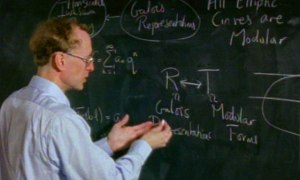
Sir Andrew Wiles, solving a problem.
Understanding the question is the initial process. You learn the motivation of the question, the required theory. Then, solving the question requires applying theory and mathematical implementation of ideas gained from understanding.
We may conclude with a good question is one that takes some time and careful thinking to solve.
But still, this is not enough. Some complicated questions require fuzzy statements (statements which have not been verified, do not exist and are not true in general and so on). Some complicated questions require numbers which we cannot fathom of.
Some need to be verified by a computer, as we cannot solve that specific part. Some complicated questions themselves are clear yet give way to fuzzy premises in an attempt to solve.
Some complicated questions are just too complicated. You can spend your whole life thinking about them, hopefully solving them. Ideally, a question is a gateway to understanding and gaining knowledge.
Few of us have the time Sir Andrew Wiles or Grigori Perelman did to solve complicated questions.
But these complicated questions are infinitely better than our easy questions. We give an example of easy questions and complicated questions.
Easy questions requires a little bit of time, some specific problem solving skills and a bit of knowledge of undergraduate mathematics.
Complicated questions require a lot of time, new problem solving skills and new mathematical knowledge.
Suppose we want to “solve” the continuum hypothesis. We would need to be comfortable with theories involved in set theory, logic and then learn the method of forcing as outlined by Paul Cohen.
With progress, we would solve several other (easier) questions which would give us more knowledge, independent of solving the original question.
There is a balance, it seems. Is a question asked with some clarity, yet with an interesting element enough?
The Goldbach Conjecture satisfies both of these criterions (clarity; it makes sense, interesting element; knowledge of primes), yet is a surprisingly (actually, unsurprisingly) complicated question, currently unsolved. Although it is of interest, there is no solution, all methods, techniques, ideas and such eventually fail.
Perhaps a good question is one that does not need to be answered. But then, why was it asked? To understand. If we understand, we will (hopefully) eventually solve.
In our modest world, it is fair, then, to say that a good question is one not simple enough to be solved in a couple of minutes; one which requires to carefully think. One requiring some non-trivial theory and to be reasonably solvable.
A question needing different theory to solve is even better.
Say we get asked to find the probability of something event happening, to do so we may need combinatorics to understand our specific event, some theorems regarding the factorial function.
Then we may need linear algebra to solve some linear equations for our distribution, then some knowledge of probability theory, perhaps knowledge of expectation, conditioning probability and such. Through this path, you see why the question was interesting; no clear path existed in solving it.
Eventually you build the intuition to create the clear paths to solve questions.
Such a question is good as you cannot cheat it. You need to think. The solution is not so obvious. A small change to the question can have no answer. But we understand. Then we move to the next question!


 Posted by AH
  Arbias Hashani