Supermarkets only have decorations during December. Ten times as many people visit in December than any other month. You enter the supermarket, what is the probability that you see Christmas decorations?
Supermarkets puzzle
February 17, 2013
 Leave a Comment » |
  Mathematics | Tagged: Probability, puzzle |
  Permalink
 Posted by AH
Transformers 3 Puzzle
January 3, 2013The movie Transformers: Dark of the Moon contains an interesting puzzle.
Sam, the main character, has an evil robot (a small Decepticon) which transforms to a watch placed on his hand by Dylan, an evil guy.
The robot/watch can understand everything Sam says and hears. It reports information back to Dylan. It can tap into Sam’s nervous system and affect him, meaning he cannot just remove it. Sam must communicate to fellow humans and good robots (Autobot’s) but he knows the whole time whatever he hears or says is accessed to the enemy.

We can build an interesting question from this.
Suppose you know person X and Y, person X works for a competing, evil company X’ and person Y works for your employing, good company Y’. Suppose everything that you communicate with person Y goes to person X and you cannot inform person Y of this.
Devise a winning strategy to defeat company X’ and for company Y’ to win.
Related mathematical fields; algebra, probability theory, set theory, number theory.
Leave a Comment » | Mathematics | Tagged: Algebra, mathematics, number theory, operational research, Probability Theory, set theory, transformers | Permalink
Posted by AH
What is a good mathematical question?
December 27, 2012What does a mathematician do? A good question.
One could say a mathematician observes and provides a logical input.
Another could say that mathematicians prove theorems.
And yet, another, could say that mathematicians solve problems.
The first is a defining feature of an even bigger question (what is mathematics?), occurring prior (and hence leading) to axiomatizing.
The second uses axioms to produce facts.
The third is to apply the first two, providing a desired answer to some question.
This post looks at what that question is. What it should be.
Formally, we are asking, what is a good mathematical question?
(We could quip in by saying, is that (and hence this) question a good mathematical question itself?)
Mathematicians spend so much of their time solving questions. Knowledge of what a good question is should help us to solve the question, independent of the question itself.
In fact, this is the point of mathematics; to provide factual statements that are independent of who is providing them.
What is a good mathematical question?
We could say one that is clear and has a purpose i.e. there is no ambiguity to solving

However, a complicated question can be asked. Life is complicated, often asking questions that seem nonsensical. Therefore, our first question is is not sufficient, certainly it may be a good question, but better can be asked.
A good question can be difficult. Sir Andrew Wiles spent some years proving the Taniyama-Shimura conjecture, which asked several difficult questions.
Some thought it would take a long time to prove as we did not know where to begin to understand the questions let alone to solve it. One man took his time to understand and as a result, we all do.
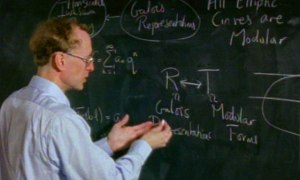
Sir Andrew Wiles, solving a problem.
Understanding the question is the initial process. You learn the motivation of the question, the required theory. Then, solving the question requires applying theory and mathematical implementation of ideas gained from understanding.
We may conclude with a good question is one that takes some time and careful thinking to solve.
But still, this is not enough. Some complicated questions require fuzzy statements (statements which have not been verified, do not exist and are not true in general and so on). Some complicated questions require numbers which we cannot fathom of.
Some need to be verified by a computer, as we cannot solve that specific part. Some complicated questions themselves are clear yet give way to fuzzy premises in an attempt to solve.
Some complicated questions are just too complicated. You can spend your whole life thinking about them, hopefully solving them. Ideally, a question is a gateway to understanding and gaining knowledge.
Few of us have the time Sir Andrew Wiles or Grigori Perelman did to solve complicated questions.
But these complicated questions are infinitely better than our easy questions. We give an example of easy questions and complicated questions.
Easy questions requires a little bit of time, some specific problem solving skills and a bit of knowledge of undergraduate mathematics.
Complicated questions require a lot of time, new problem solving skills and new mathematical knowledge.
Suppose we want to “solve” the continuum hypothesis. We would need to be comfortable with theories involved in set theory, logic and then learn the method of forcing as outlined by Paul Cohen.
With progress, we would solve several other (easier) questions which would give us more knowledge, independent of solving the original question.
There is a balance, it seems. Is a question asked with some clarity, yet with an interesting element enough?
The Goldbach Conjecture satisfies both of these criterions (clarity; it makes sense, interesting element; knowledge of primes), yet is a surprisingly (actually, unsurprisingly) complicated question, currently unsolved. Although it is of interest, there is no solution, all methods, techniques, ideas and such eventually fail.
Perhaps a good question is one that does not need to be answered. But then, why was it asked? To understand. If we understand, we will (hopefully) eventually solve.
In our modest world, it is fair, then, to say that a good question is one not simple enough to be solved in a couple of minutes; one which requires to carefully think. One requiring some non-trivial theory and to be reasonably solvable.
A question needing different theory to solve is even better.
Say we get asked to find the probability of something event happening, to do so we may need combinatorics to understand our specific event, some theorems regarding the factorial function.
Then we may need linear algebra to solve some linear equations for our distribution, then some knowledge of probability theory, perhaps knowledge of expectation, conditioning probability and such. Through this path, you see why the question was interesting; no clear path existed in solving it.
Eventually you build the intuition to create the clear paths to solve questions.
Such a question is good as you cannot cheat it. You need to think. The solution is not so obvious. A small change to the question can have no answer. But we understand. Then we move to the next question!
Leave a Comment » | Mathematics | Tagged: Continuum Hypothesis, Goldbach Conjecture, Hilbert Problems, mathematics, Probability Theory, Project Euler, Sir Andrew Wiles, Taniyama-Shimura Conjecture | Permalink
Posted by AH
An Introduction To Stochastic Calculus
October 30, 2012When performing integration, differentiation, evaluating sums and products; our evaluations use numbers (usually real, sometimes complex). They define the “answer” we get; a physical interpretation into understanding what we have done.
Suppose instead of numbers, we use variables. Specifically, we use random variables. Then we are using a new calculus; appropriately named stochastic calculus, stochastic meaning random.
This post is not going into probability theory nor will it define what a random variable is, specifically we introduce stochastic calculus without any extreme formality.
Suppose you want to look at the stock market, or anything that enough humans touch in response of being able to gain something in return, say an environment. Say we define 


How small does dt need to be?
What happens when it’s infinitesimal?
Does it relate to some specific probability distribution?
Can we make a formula for X without involving any explicit, complicated functions?
First we continue with our asset, given a change in time, we have a change in price 
Suppose the asset’s environment is responsive to change and there are many users like us, the controller of the asset; all looking after their asset. Is the change in the asset price simply just how the market fluctuates at the given time, multiplied by some constant for normalisation?
Suppose this is true and thus we have the differential equation 
(where 

Integrating and using some initial condition (
We have

For short time periods (specifically, for really short) it works fine. But it’s hugely problematic.
As time increases, the probability of the asset having a negative price is bigger than zero, ie non zero, therefore it can happen on some day, or specifically some time period. Formally we have the statement “
Initially we think it’s not too probable but just that it exists gives us problems. Who’s going to trust or use some differential equation that says the probability of the asset having a negative price at some future time using that differential equation is non zero?
So we go back to our differential equation. Do we start over again? Not really, we just think sensibly. Suppose I have some hot tea that I want to drink it when it is just right. So I let it “play” in the environment and then make a judgement on whether I should drink it or not.
Relating to our problem, an investor or user of an asset will look at the potentials gain or loss (change)
So we have the relative price change to be the proportional to market fluctuations, we have

Now by integrating from the initial price to the variable 
Surely we can solve this, right? Trying our usual elementary methods makes no sense since our 
Unless we define a new integral equation and a new kind of calculus; the counterpart to real numbers, one for random variables. We have stochastic calculus.
Questions:
What happens when the time increments approach zero? (Brownian Motion)
With limiting zero time increments do we have a differentiable market fluctuation function? What probability distributions do we use to understand how this process works? (Poisson process)
What new type of integral do we define to solve the weird integral we have on the right hand side? (Ito integral)
This new integral must apply to some kind of calculus given that we will be differentiating it at some point and other proper tires, specifically what is this calculus and what special defining properties does it have? (Stochastic calculus)
Here we stop given that the questions asked cover enough of the motivation to study stochastic calculus, however for further enthusiasts we ask more questions and give some new ideas.
Given a discrete random variable mapped by some specific distribution, in between time intervals we can actually use a continuous random variable to “travel” through the time increments. The related distributions are the Poisson and Exponential (and discrete analogy Geometric). How can we use these distributions to understand what is happening in our asset price change, or in our differential equation?
This
Stochastic Calculus requires good knowledge of probability theory, real analysis, linear algebra and a few other bachelor level modules (complex analysis, differential equations, Hilbert spaces) to fully let it sink in.
Leave a Comment » | Mathematics | Tagged: calculus, integral equation, Ito, Ito integral, Riemann integral, Stochastic | Permalink
Posted by AH
Lecture 1: Sets, Real Numbers, Fields, Ordered Fields
October 30, 2012The real number system is a set 


Given any (and all) 
(A) 

(B) 

(C) 
(D) There exist distinct real numbers 


(E) For each 


A set on which two operations are defined so as to have properties (A) – (E) is a field.
Motivation: Think about these properties for a second before moving on. (A) establishes what the operations do, (B) then asks what happens when we include more elements, a “double operation” if you like. (C) then mixes the two operands into one. (D) and (E) are closely related. Suppose we want to add an element to our given real number that… gives us our real number? So we are adding nothing, or
Then we ask, can we find real numbers that give us what we just discovered, namely
Exercise: Can you think of another example of a field?
Exercise: Do the set of integers 
The real number system is ordered by the relation 
(F) For each pair of real numbers 


(G) If 


(H) If 


A field with an order relation satisfying (F) – (H) is an ordered field. The real numbers (and rationals) form an ordered field.
Suppose we get bored of the real numbers and define a new field satisfying everything 


Exercise: Verify that
Exercise: Is
(Hard) Exercise: Why have we defined 
Questions to think about:
Are all fields ordered fields?
Are finite fields ordered?
What do these two above questions (if and when answered) say about ordered fields? (Hint: Infinite number of…)
Leave a Comment » | An Introduction To Real Analysis, Mathematics | Tagged: analysis, mathematics, real, real analysis | Permalink
Posted by AH
The Motivation Behind Real Analyis
October 21, 2012When I ask anyone who is not a mathematician (and even some who are) what a “number” is, they never define what a “number” is, but say something along the lines of “well a thing you add to get another thing, like 2+2=4”. But here we had defined “+”, which I do not know of, have not defined and do not have much care for; I asked a different question. We see numbers as “left and right” on some big “interval”, this is also wrong. We will see this by the end of the first lecture.
The motivation behind this course is to build some proper rigour into understanding what, how and why analysis is/operates/works.
(When probability is taught wrong, it leads to bad knowledge of quantum physics, statistics(bizarrely), stochastic models, differential equations. Anything with randomness.)
When real analysis is taught wrong, it leads to bad knowledge of everything taught later on in maths: probability, calculus (vector calculus too), geometry, complex analysis, Fourier analysis, group theory, just a few to name, really cannot be taught without some specific and excellent knowledge of real analysis.
It makes sense (which through out this blog I will be saying… a lot) to begin with my notes for the course “An Introduction To Real Analysis”.
But… What if you have no mathematical knowledge? No worries. The prerequisites are nothing. Especially not calculus (integration or differentiation). But you should have some mathematical ability, what do we assume? That you know that a “real number” is. That is all. You do not even need to know what addition or multiplication are. To be honest; I hope you do not.
If you do have some mathematical knowledge, the notes will not be so interesting but the excercises should keep (some are very difficult, some very easy) you awake. And if you have a lot of mathematical knowledge, you may wish to simply download these notes for your own need; to teach others as a lecturer, as a prerequisite to your course, or just to have some real analysis notes, which is always handy.
2 Comments | An Introduction To Real Analysis, Mathematics | Tagged: motivation, real analysis | Permalink
Posted by AH
 Arbias Hashani