It’s a good question. Prod further down the line and you begin to ask why we even need rigorous mathematics. A simple (motivating) example is sufficient to understand why calculus that extends to dealing with random phenomena is needed.
We know with certainty that the sun will shine in the morning and the moon will be fluorescent at night. All we need to do is look outside the window and we’ll know which event occurs: we have total information. What happens when we don’t have so much information? Consider an atom, unobservable to the human eye. The uncertainty principle tells us we cannot know full information about this atom. Further-more, the act of observing the atom perturbs its movement a little bit.
In a classic, information-rich scenario, the instantaneous change of some phenomena is given via a classical mechanical framework
change in system = deterministic function of system
or in mathematical symbols,

We know add some perturbation 
change in system = deterministic function of system + random perturbation
or in mathematical symbols,

As this perturbation is not known a priori (if it were, the system would be deterministic), we call it random!
Classic calculus does not deal with anything related to ‘random’ and it is why a new form of calculus is needed: for systems that are random over time, i.e. stochastic systems, i.e. stochastic processes, hence the name stochastic calculus.
If we are not careful, we may have a new form of calculus that leads to nonsensical results, which is why we must be rigorous.
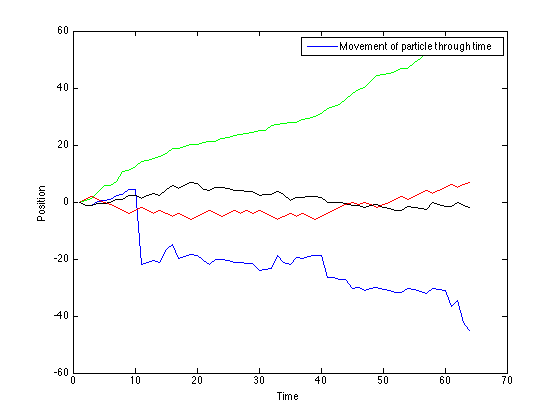
Below is a plot of a particle in integer time-steps with different perturbations
 Arbias Hashani